
The Smell Lab and the Narcan Analogy
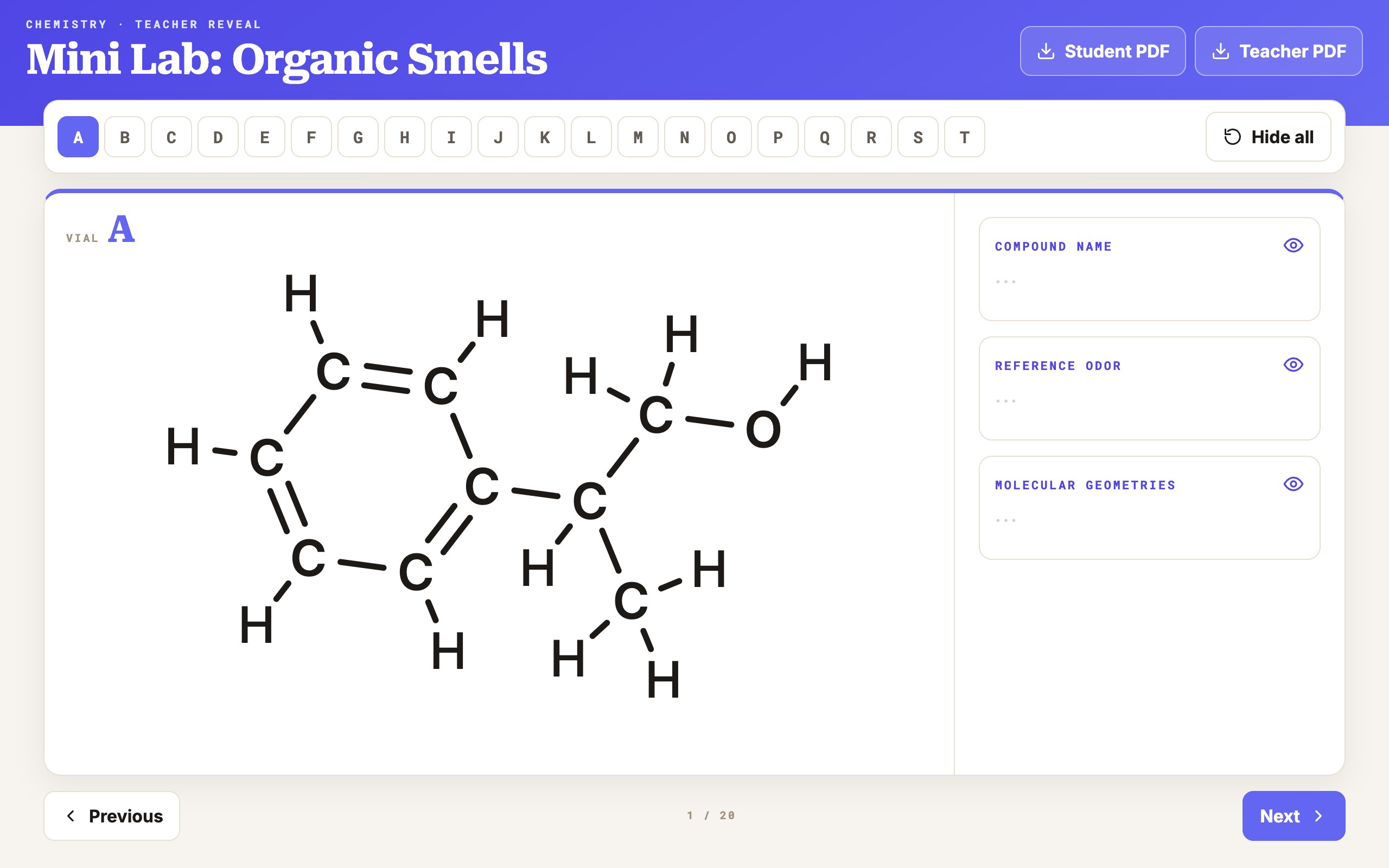 Vial A on the projector. Students smell first, write a hypothesis, and only then do we reveal.
The organic smell lab is about as familiar as chemistry labs get. Twenty little vials, lettered A through T, each holding a molecule that smells like something you know. Roses. Banana. Wintergreen. Vanilla. Students waft, guess, and write it down. It's fun, it's a little chaotic, and it usually ends with "cool, molecules smell."
This year I didn't want to replace it. I wanted to look at it differently.
Why smell, why now
Right before this lab, my chemistry students had been deep in fentanyl. We watched two documentaries, and the job was to write down five new things learned from each one. We talked about opioid receptors, why fentanyl is so dangerous in such tiny amounts, and how Narcan (naloxone) can reverse an overdose. If you want the backstory on how I first brought this topic into the lab, I wrote about using chemistry to imitate the brain's protective layer a couple of years ago.
The big idea underneath all of it was structure and function. A molecule's shape helps determine what it can fit into, and what it fits into helps determine what happens in your body. That's a big part of the story of an opioid overdose, and it's also a big part of the story of your nose.
So the smell lab stopped being a party trick. It became a safe way to feel structure and function play out in receptor binding, right there in the room.
The lab, through a different lens
I used the Flinn Organic Smell Identification kit and built a small projection app, Mini Lab: Organic Smells, to run the reveals. One vial at a time. The structure is on the board the whole time. Students smell, write a hypothesis and the molecular geometries they see in their notebook, and then I reveal the compound name, the reference odor, and the geometries, one toggle at a time.
The pair I was most excited to reveal was vials F and G.
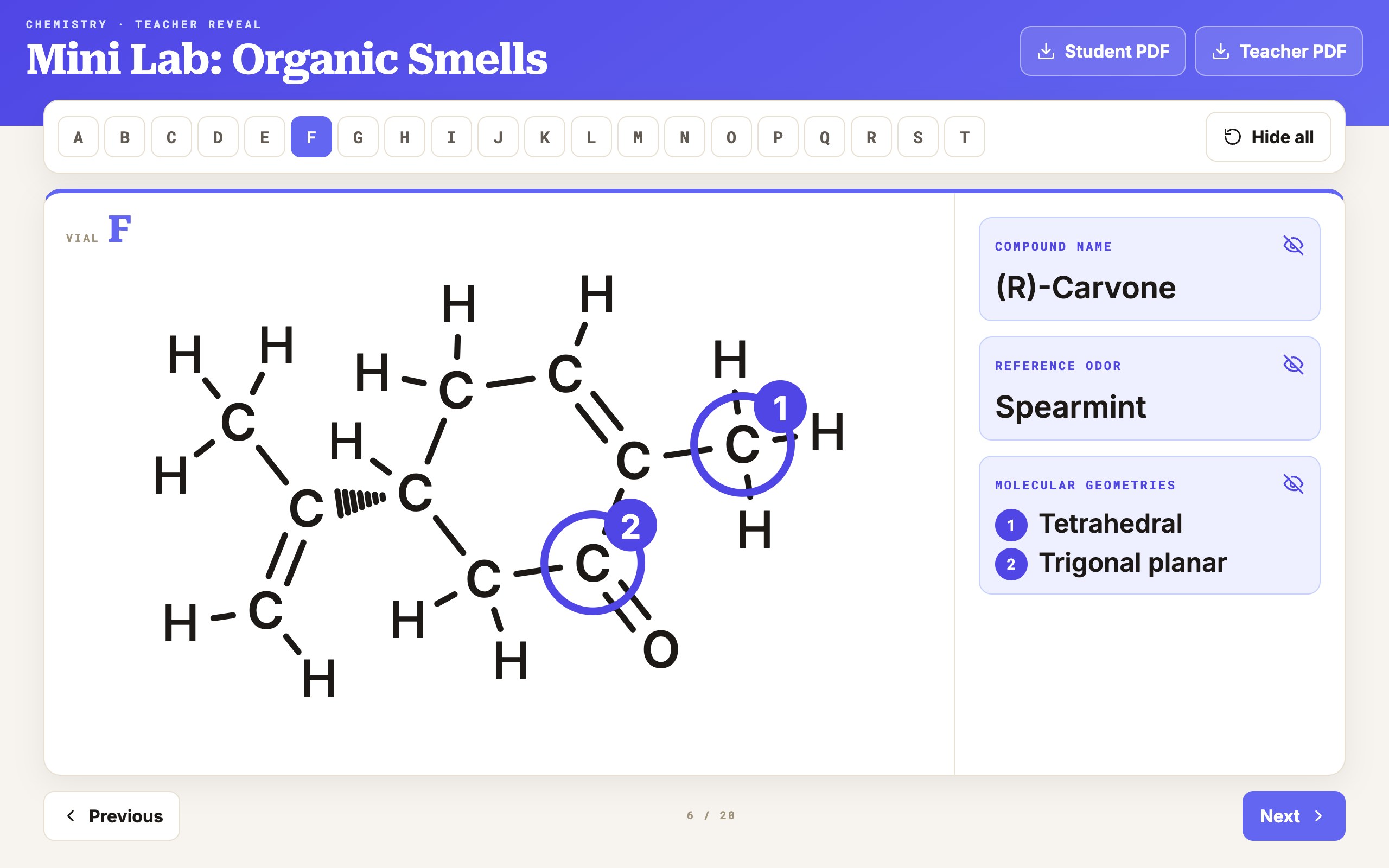 Vial F, (R)-carvone. Spearmint.
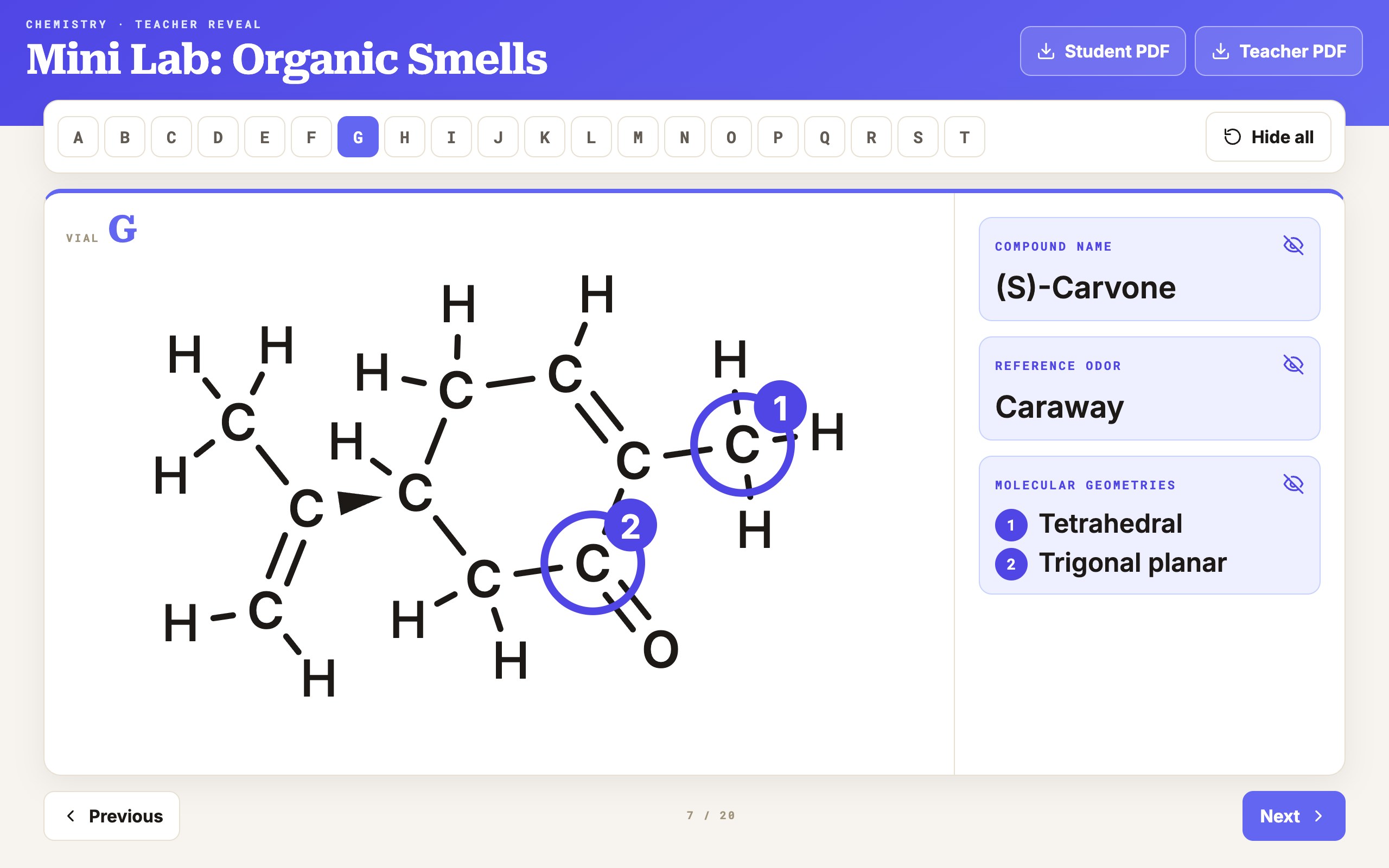 Vial G, (S)-carvone. Caraway, the seed in rye bread. Same atoms, mirror image.
Same formula. Same atoms. Same bonds. The only difference is which way one group points in space. One smells like spearmint gum and the other smells like rye bread. If you ever needed proof that shape matters to a receptor, it's sitting in those two vials.
Between scents, students sniffed coffee beans to "reset" their noses. And in the moment, I leaned into it. Coffee is the Narcan! Clear the receptors, get ready for the next molecule.
The analogy, and where it breaks
After the lab, I brought everyone back to fentanyl and asked one question:
"How might what we just experienced be analogous to what we learned about opioids and Narcan?"
The similarities are real. In both systems, a molecule's structure shapes how it interacts with receptors, and those interactions kick off a biological response. Fentanyl is an agonist at opioid receptors: it binds and activates them. Naloxone is a competitive antagonist: it competes for those same receptors without activating them, which can reverse the opioid's effect. In the smell lab, volatile organic molecules activate overlapping combinations of olfactory receptors in the nose. The brain interprets those patterns as "spearmint" or "banana."
And then I had to walk back my own line. Coffee beans are not Narcan.
Coffee odor molecules don't reliably knock the previous molecule off an olfactory receptor, and they don't act as antagonists that reset the system. Honestly, the whole coffee bean trick has pretty limited scientific support. What's actually happening is that coffee introduces a brand new set of sensory signals, while olfactory adaptation (your nose getting used to a smell), changes in how responsive the neurons are, and plain old attention all shape what you notice next.
I told my students that directly. I set up the analogy, and now we were going to take it apart.
That turned into a bigger question:
How can different molecular interactions and biological mechanisms lead to different sensory experiences and physiological responses?
We talked through the chain: molecular structure, receptor recognition, receptor activation, and the nervous system's interpretation of the signal. We also stepped back and looked at the other senses. Smell, taste, touch, and vision all detect the world, but they use different kinds of receptors and different signaling mechanisms to do it. Receptor binding is a common principle across biology. That does NOT mean every receptor works the same way, or that every response runs on the same mechanism.
What I keep thinking about
What started as a familiar smell lab became a way to revisit the chemistry behind a lifesaving medication, explore how sensory perception actually works, and look hard at the limits of a scientific model.
I didn't need a new lab. I didn't need an elaborate new activity. I needed a different conceptual lens, a connection to something that matters in my students' lives, and a question that asked them to transfer what they knew.
The most valuable part wasn't spotting the similarities between the two systems. It was finding the differences and realizing those differences matter. Analogies are useful precisely because we can investigate where they hold up and where they fall apart. That's what scientists do with every model.
I'll be honest, I didn't plan for my coffee line to become the centerpiece. But that's sort of the point of inquiry. It keeps going even after you think you've found the explanation, and sometimes the thing that keeps it going is your own imperfect idea.
Sometimes an imperfect analogy, examined carefully, can become an even more powerful learning experience than a perfect one.
The app, with its student and teacher PDFs, is free, and it lives on my Projects page if you want to try it with your own kids.
Keep reading
New writing, when there is something worth sharing.
Notes on curiosity, inquiry, science teaching, and building the lesson.
No spam. Unsubscribe anytime. Prefer RSS?
Related reading
Exploring Fentanyl's Risks: Using Chemistry to Imitate the Brain's Protective Layer
This lab activity directly tackles a pressing issue: the opioid crisis, with a spotlight on fentanyl, one of the most potent and problematic drugs out there. This isn't just any experiment; it's a...
Read →Stoichiometry as a Board Game
For years I taught stoichiometry with ICE tables. I still love what they model, but this year I tried something different: a one-page house that is both the solving sheet and the game board.
Read →Explore New Experimental Lessons, Resources, and Artifacts Page!
Dear Readers and Subscribers, I wanted to share some exciting news with you! Over the years, I’ve been working on creating lessons that are a bit outside the box, blending technology, science, and...
Read →