|
|
|
Engage Hero is Called
Explore Hero is Challenged
Extend Hero is Transformed
Evaluate Hero is Judged
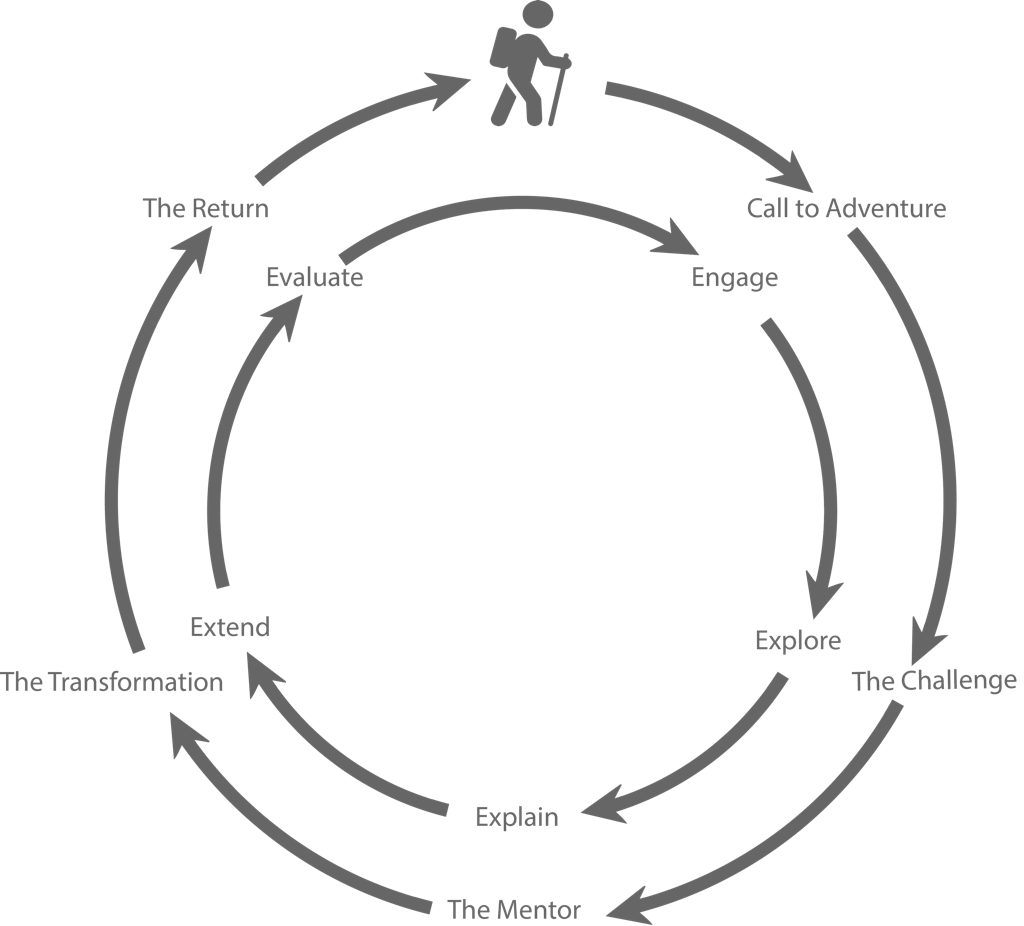
All lessons based on the 5E Learning Cycle/Hero's Journey overlap shown below:
Albeit corny, I don't think a blog post goes by where I don't allude to the beautiful connection between the 5E Learning Cycle and Joseph Campbell's Hero's Journey. Our students are HEROES and our standards are their JOURNEY. Why not!?! It certainly makes lesson planning more fun...meaningful...etc. Click here, here, and here for past writing and literature about this connection. Keeping the above in mind, I was planning for parent Back to School Night last week. Teachers at my school are challenged to design a 20 minute lesson, for each section, to model their pedagogical style, content, etc. Not an easy challenge. A few days before the night I began preparing my typical "Coke vs. Diet Coke" activity where parents engage in an inquiry activity around why a can of Coke sinks in water and a can of Diet Coke floats. See image below: 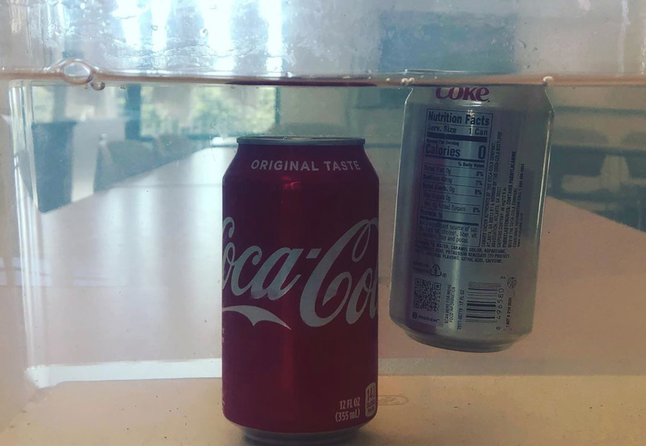 Normally I begin the activity by showing parents the above demo, then asking: "What questions do you have?". Subsequent discussion leads to definitions of mass, volume, density, and if time, quantitative measures of the mentioned variables.
This year, I set out to do something else: Model an entire 5E/Hero's Journey Cycle, in just 20 minutes. At least scratch the surface of each anchor point in the cycle to take the activity beyond the simple density example, to questions surrounding chemical structure, sweetness, biochemistry, etc. (note: this desire was primarily catalyze by the need to begin lesson planning for a Medical Biochemistry advanced elective I will be teaching next semester. More on that later for sure...) Below is the outline of the lesson that I will be expanding into a full learning cycle using this template in the next month or so. Stay tuned! PHASE 1: EXPLORE (Call to Adventure)
I have written to annoying lengths about my love for the connection between the 5E Inquiry Learning Cycle and Joseph Campbell's Hero's Journey.
The below diagram outlines the serendipitous connections between these two cycles well: 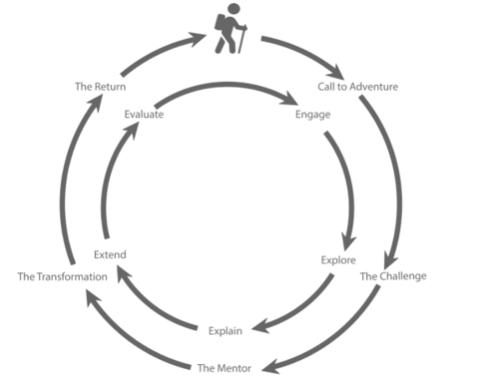
In preparation for a professional development workshop I facilitated yesterday, I created a lesson planning template based on the above connection that I am very happy with.
My hope is to use a copy of the template for each cycle I create in my biology and chemistry classes for the upcoming semester. Unlike previous templates I have used, this one leverages a Google Slide template, as a planning, rather than presentation document. The flexibility of editing slides, embedding video, etc., makes Google Slides an incredibly flexible medium. You will notice that each of the five phase of the 5E/Hero's Journey cycle hyperlinks to an associated slide. I love this feature as it creates a contained pedagogical cycle, allowing the teacher to focus on each phase individually, IN THE CONTEXT OF THE WHOLE. As an educator, this connectivity is very comforting, and as Jon Stewart said: "A structure that allows for creativity". You will notice that each slide has two portions: 1) Lesson Procedure and 2) Technology integration. By "tagging" the technology on as an afterthought, this template forces the teacher to first think pedagogically (How does this procedure serve the inquiry cycle as a whole?), then procedurally (How will I make structure the class to accomplish the goal of the specific portion in the cycle?) and finally technologically (How can I leverage technology to make this lesson even more efficient, productive, meaningful, etc.?). Thus, technology serves the pedagogy by simply following the template. An ideal teaching tool IMO. Click here and "make a copy" of the template for your own use. The template is also embedded below for ease of viewing. Enjoy! A few weeks ago I had the pleasure of working with the science educators at D211 in Chicago's Northwest Suburbs. As part of the workshop, all teachers were challenged to work in discipline specific teams to create an outline for an NGSS aligned, 5E Learning cycle. They were too good not to share! Click on the image below to access all lesson outlines. Enjoy! 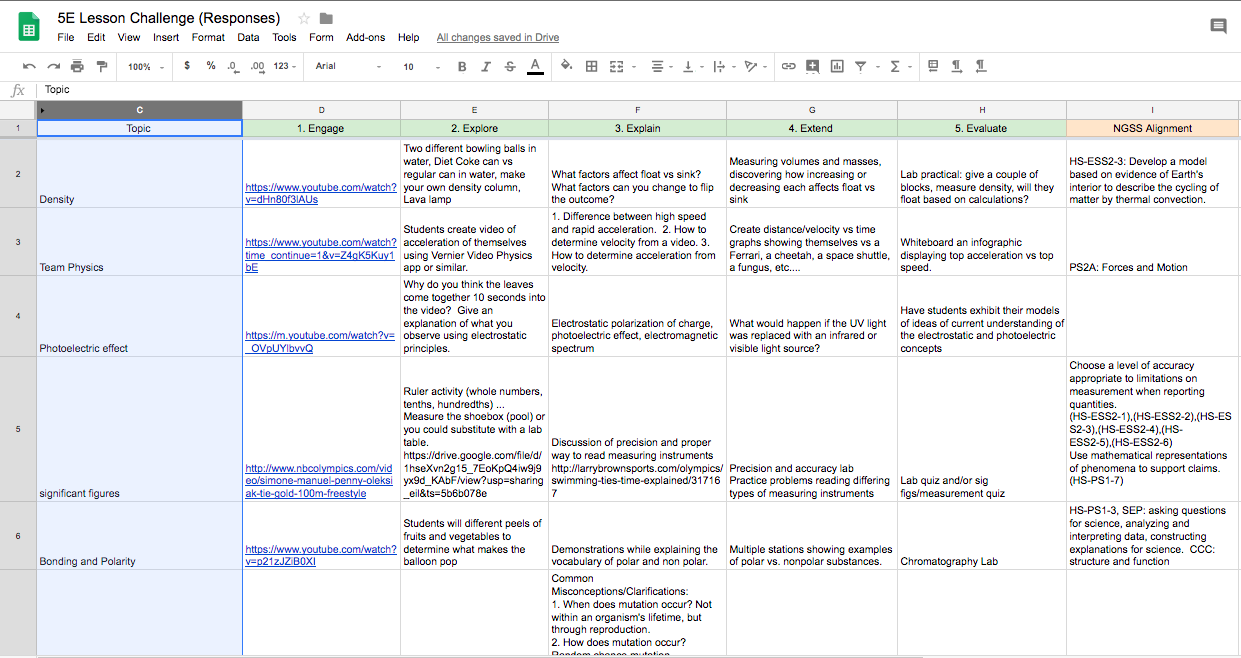
I have written many times before about the connection between the 5E learning cycle and Joseph Campbell's Hero's Journey. Click here for a diagram that pairs the two processes together well.
Perhaps the most important part of the shifting one's instruction to an inquiry learning cycle approach is challenge of "Calling Students to Adventure", engaging them by strategically sparking their curiosity. The goal of this process is to STRATEGICALLY elicit spontaneous questioning about a topic in such a way that students begin to ask question about the lesson plan you have already created. Yes, you could ask them the questions directly. However, I find when the questions come directly from the students they are markedly more engaged and empowered. Below is an example of a "spark" I recently found that I plan to use in my chemistry class during the 2018-2019 school year: Electrochemistry, specifically the intricacies of oxidation and reduction tend to be challenging ones to engage students in. The process of electron flow can be a challenging one to visualize, and beyond making batteries with lemons, nails and pennies, finding a simple, tangible, and engaging way to created a window into the topic and spark spontaneous, natural intrigue about the topic is something I have yet to do successfully. Keeping this in mind, this summer I spotted one of my 5th grade science camp students dropping a AA battery and watching it bounce. When I confronted him he said: "If it bounces it's empty. If it doesn't it's full". At the time wasn't yet aware that this "bounce test" was a viral internet phenomenon. After sitting there watching this young camper test battery after battery I found myself asking questions: "Why does it bounce?" "Why does it not bounce?" "Is this real?" "Is this a hoax?" After contemplating the process, and scribbling the inner workings of an electrochemical cell on the adjacent whiteboard in search of a personal explanation, I finally resorted to the internet and found a few articles on the topic. This article was the most comprehensive and successfully quenched my curiosity. I also found this video on the topic, which gave me an idea of a potential student activity on the topic. After spending a few hours reviewing all of the videos on the topic, I decided to create my own battery bounce test curiosity spark on the a few day ago. A simple video that gets to the heart of the issue, and makes the information gap as salient and as clear as possible with the goal of tunneling students into the same questions I asked above. Click here to see the video or view below: Essentially I had gone on my own Hero's Journey..Embodied my own 5E Learning cycle..Lived the metaphor that I speak of so much when working with other teachers or writing blog posts (like this one!). The young 5th grade science camper ENGAGED me with his battery bounce test. The subsequent information gap forced me to EXPLORE reasons for this by accessing my prior knowledge. My lack of ability to resolve this perplexity led to a need for a mentor (the internet) to help me EXPLAIN the concept. I am now EXTENDING this concept, converting it into a lesson plan for the upcoming school year, and will EVALUATE the lessons efficacy when done.
If you found the information in this message useful to your practice, I invite you to learn more about becoming a site member. Monthly membership includes, but is not limited to, frequent distributions of detailed online video courses, lesson plans, teaching websites, curricular resources, and access to webinars exploring the world of curiosity, inquiry, and technology in the classroom. Additionally, you can find a copy of my new book, "Spark Learning: 3 Keys to Embracing the Power of Student Curiosity", by clicking here.
|
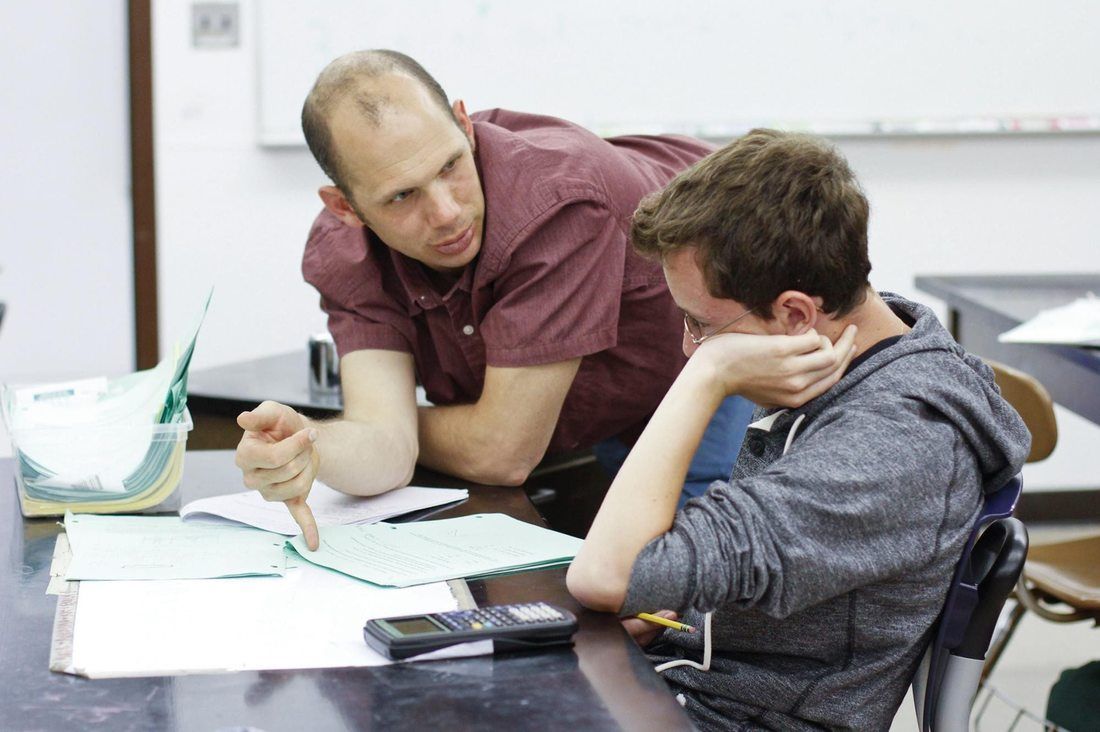
Ramsey Musallam is a full-time science teacher in Santa Rosa California.
Categories
All
Archives
February 2024
|
 RSS Feed