Explore-Apply over Break: Paperless Turn-In
Although I am against assigning problems for students to do over holidays, the realities of teaching an AP curriculum sometimes demand that I do. This Thanksgiving break came directly in the middle of a Level (Unit) on gases, so I wanted my students to stay sharp over break. Instead of assigning problems, I asked students participate in the same inquiry process, beginning with higher Blooms (exploration/creation), ending with application (solving problems, discussion, etc.) that we participate in during the normal school year.
First I posed a situation by posting an image with a set of questions in a private Google Form. The screenshot below shows the task structure.
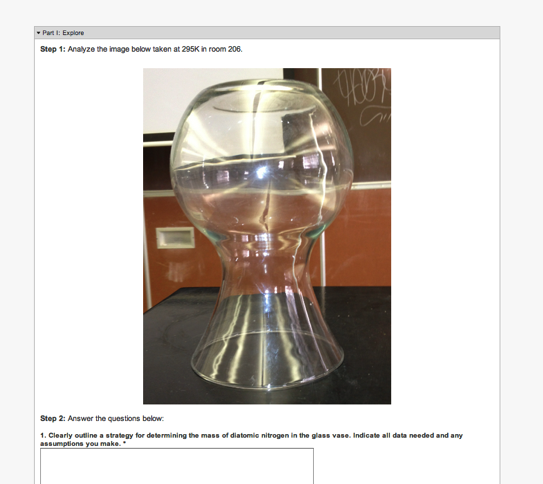
After students participated in the exploration, I assigned the typical reading and application problems. Instead of collecting hard copies, I asked students to photograph their solutions and submit them through the private form. That created one restricted collection I could analyze for class-level mistakes and misconceptions alongside the earlier experimental designs.
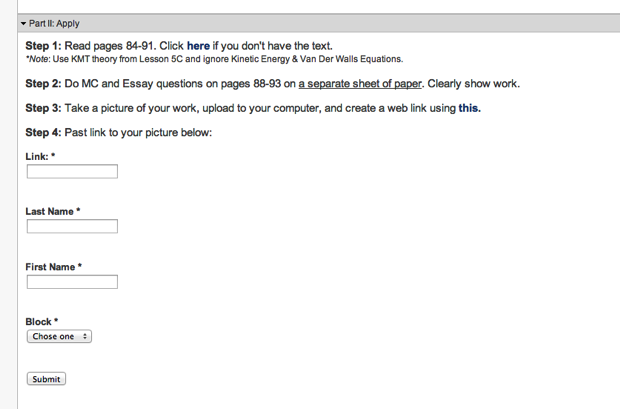
The second screenshot shows the submission fields without exposing the live response sheet.
In order to guarantee that students were “locked” into the inquiry cycle (participated in the exploration prior to the application), I told students they would receive three points for the assignment: 1 point for the exploration, 1 point for the application and 1 point if their exploration submission is time-stamped prior to their application time-stamp. Although it seems like a like or work to sift through (and it was) organizing all things via two google forms that are individually time-stamped added efficacy (I think) to a process (homework) that I often feel can be very ineffective in that I was able to keep students questioning and forming hypothesis prior to application, which is the goal of our inquiry driven classroom structure. Moreover, the paperless turn-in allowed me to assess student work prior to class to facilitate a more critical and informed class the first day back.
Keep reading
New writing, when there is something worth sharing.
Notes on curiosity, inquiry, science teaching, and building the lesson.
No spam. Unsubscribe anytime. Prefer RSS?
Related reading
Escape Room Lab
I wanted a classroom escape room builder that was free, content-first, and took about ten minutes to use. I could not find one, so I built Escape Room Lab. Here is how it works and how to use it with your own students.
Read →Stoichiometry as a Board Game
For years I taught stoichiometry with ICE tables. I still love what they model, but this year I tried something different: a one-page house that is both the solving sheet and the game board.
Read →Build the Tool, Don't Find the Tool
A classroom question about blinking became a purpose-built data tool and a case for building the app a lesson needs.
Read →